
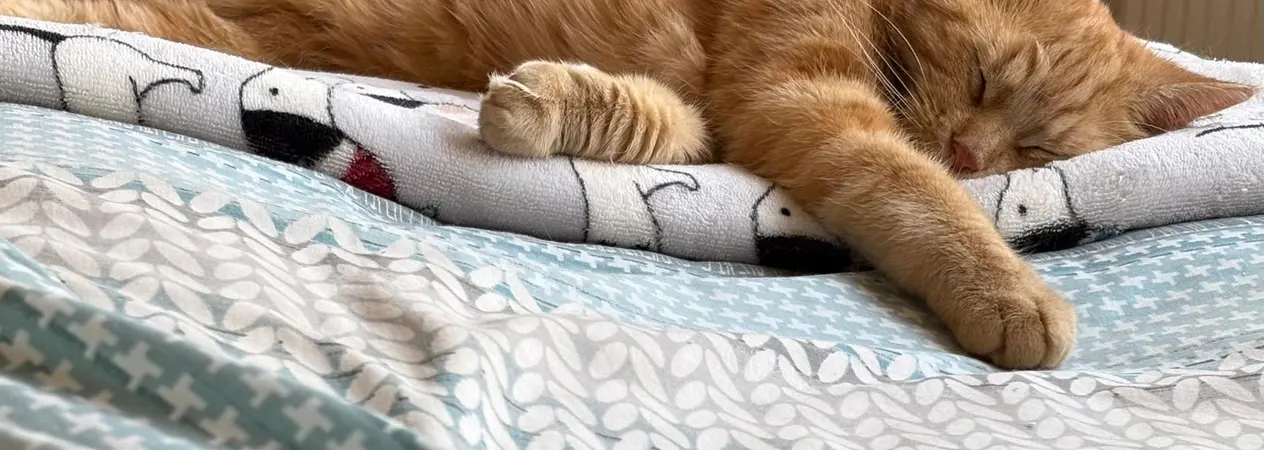
Beryl's toilet troubles are solved
It took time and patience in Blue Cross care
Pets often arrive at Blue Cross with behavioural problems formed during their previous – sometimes difficult – lives. Sweet little Beryl, who weighs less than two kilos, is a case in point.

One of 40 cats from the same household, Beryl quickly charmed the team at our Bromsgrove rehoming centre with her gentle and affectionate nature. She’d obviously been loved and enjoyed being cradled in her carer’s arms and gently rocked, like a baby.
But it soon became clear Beryl had an issue that might make her difficult to rehome. She suffered from inappropriate toileting and didn’t use her litter tray.
First step was to rule out any medical reason for Beryl’s issues – when Beryl was given a clean bill of health by our vets, the team looked for a behavioural cause.
Blue Cross advises one litter tray per cat in a household so nobody has to share – and one extra as a failsafe. Cats are private creatures and can feel vulnerable when toileting. The Bromsgrove team suspected that in Beryl’s previous home there had been too few trays for 40 cats and poor Beryl had become confused.
They tried different types of litter, moving the trays around her kennel and even installing a camera hoping it might provide clues as to Beryl’s behaviour.
Then Sarah Galvin, Foster Coordinator at Bromsgrove, stepped in and offered to foster Beryl.
“I wondered if she might find figuring out how to use her litter trays easier in a home where she was the only cat,” Sarah says. “At the centre she was on a corridor with some former inhabitants of the 40-cat household – she could smell and hear them. Maybe, at home with me, she’d relax.
“Also, I’d become very fond of her in the centre, spending a lot of time with her. And I love ginger cats. About 80% of ginger cats are male, so as a teeny little ginger girl, Beryl was unique.”
Sarah chatted to a Blue Cross behaviourist before taking Beryl home – every Blue Cross fosterer or adopter has access to tailored support from the Blue Cross behaviour team.
“I asked how to set up my spare room for Beryl and whether I could use shredded paper in one litter tray, leaving the second empty,” Sarah says. “Perhaps Beryl just didn’t like the feel of cat litter under her paws. Chatting to the behaviourist and knowing they were on hand with advice gave me confidence. I really wanted this to work for Beryl.”
So Sarah set Beryl up in her spare room with a tray on one side with shredded paper in and an empty tray on the other side. And… it worked!
“There were a couple of accidents the first day but then it all clicked into place for Beryl,” Sarah says. “She used the tray with paper for weeing and the empty tray for the other. I was so relieved.”
Next step was to give Beryl the run of the house – and hope her top marks for toileting persisted. She was good as gold, returning to the litter trays in her original room when nature called.
“We’d cracked it,” Sarah cheers. “And I realised I couldn’t let her go – I wanted to adopt her. She’s just so sweet. If I go up the stairs she races me so that she can reach the landing first and roll over for tummy tickles. And she loves sitting on my shoulder. She’s a star.”
For Beryl, spending a penny is proof that perseverance pays.

