
Life-saving blood transfusion for brave Mollie
Mollie the dog’s barking rang through the corridors at Blue Cross Grimsby animal hospital – and it was music to her owner Dave Sutherland’s ears. Two days earlier Mollie had been desperately ill, so weak that our vets were amazed she was able to walk through the door unaided.
Now she was on the road to recovery as Dave could hear for himself when he phoned to check on her.
“I burst into tears when I heard Mollie barking,” Dave says. “She sounded like her normal self and I was so relieved. I’d been terrified I’d lose her.”
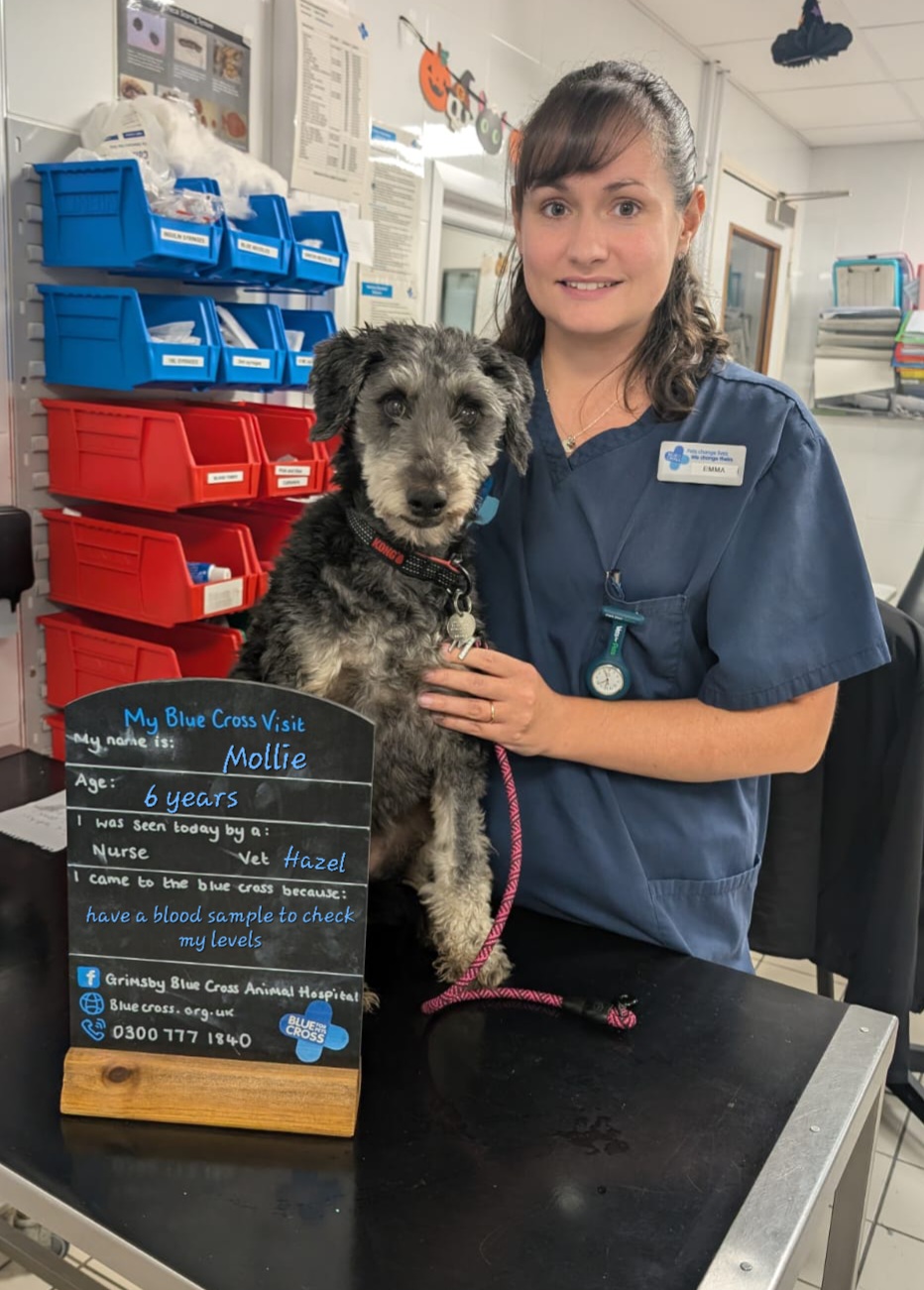
Six-year-old Mollie, a Heinz 57 rescue dog, lives with Dave, her sister Dixie and two cats just a few miles from Blue Cross Grimsby. Dave’s animals are his family so when Mollie seemed out of sorts he was concerned.
“Every evening Mollie and Dixie run down the garden, barking their heads off at imaginary dogs and foxes,” Dave says.
“Normally, Mollie is the one in the lead with Dixie following. I rescued the girls together from a puppy farm and Mollie is confident and outgoing so Dixie, who’s shy, looks to her for guidance. But one evening I noticed Mollie was lagging behind on their evening garden sprint – Dixie found herself in front. She was confused too.
“Over the next few days, Mollie became more lethargic. She didn’t want to play with Dixie or go out on walks. And she was off her food. I offered her scrambled eggs, chicken and rice – her favourites – but she’d have a sniff and walk away. So, concerned, I made an appointment at Blue Cross.”
We were amazed she'd had the strength to walk through the door
Mollie and Dixie had both been patients at Blue Cross Grimsby for five years, with Dave, who’s taken early retirement because of ill health, taking them in for check-ups, vaccinations and dental work. But this time, when the Blue Cross vet team examined Mollie, they were worried.
“We took Mollie’s bloods and were amazed she’d had the strength to walk through the door,” Emma Burnett, Staff Nurse at Grimsby (pictured above), says. “Our vet Lynne diagnosed Mollie with a condition called immune-mediated haemolytic anaemia (IMHA) which causes a patient’s immune system to attack the red blood cells leading to severe anaemia. Mollie’s red cell count was eight per cent – the normal range for a healthy dog is 28 to 34 per cent. Anything below 10 is critical.”
There are many potential causes of IMHA – infections, reaction to medication and even genetics. The cause of Mollie’s illness was unclear but the priority, with her life in danger, was curing it.
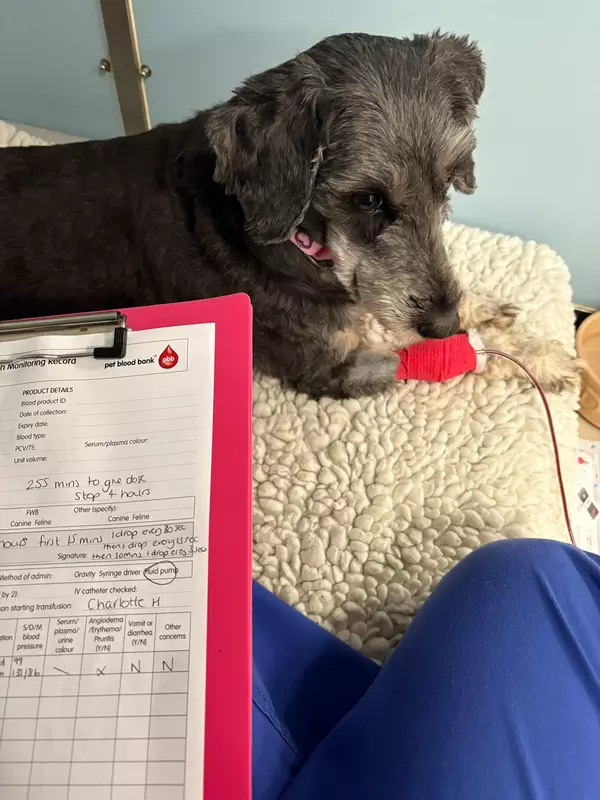
“I was so scared,” Dave says. “The Blue Cross team were kind, as always, but they had to tell me the worst-case scenario. But they said Mollie was brave, walking in on her own four legs despite how weak she must have felt – practically on the point of collapse – and that they would try a blood transfusion to see if her numbers rose. They didn’t offer false hope but I left knowing they’d do everything they could to save Mollie’s life.
“When I got home without Mollie, Dixie was beside herself with anxiety. I told her: ‘Your sister is in the best place. Blue Cross will do everything in their power to save her.’”
Mollie was given intravenous fluids while nurse Megan called the Pet Blood Bank UK – a charity, founded in 2007 – to order 250mls of whole blood, enough, the Grimsby team hoped, to boost her red blood cell count to 20%.
“Blood transfusions are a rare intervention and not suitable for every anaemic patient – we only do a couple a year,” Emma says. “We’re so grateful to the furry blood donors and their owners who give up their time to help dogs like Mollie.”
Throughout the transfusion, which lasted two hours, Mollie showed real courage.
“It took nurses Charlotte and Megan a few attempts to find a vein for the intravenous catheter,” Emma says. “I held Mollie while they tried. She was so still – she didn’t struggle or panic, just kept her big worried eyes fixed on me.”
Catheter in, the transfusion began. Charlotte sat with Mollie to closely monitor and comfort her.
“It’s extremely important to monitor dogs having transfusions, especially in the first 30 minutes, in case they have an allergic reaction to the blood,” Emma says. “Mollie lay beside Charlotte, calm as anything – she was a beautiful patient. And, when the transfusion had finished and we removed the catheter, she gave a little cheeky bark. That was wonderful as it meant her energy levels were rising.”
Two hours after the transfusion, Mollie’s red blood cell levels had risen to 33 – top of the range for a healthy dog. And, another good sign – that evening she wolfed down some food.
Next day she was stronger still. The Grimsby team had placed Mollie in the kennel next to the nurses’ station, to keep a close eye on her. And, when Dave rang for an update on her progress and she heard his voice, she barked. Joy all round!
Four days after Mollie arrived in hospital, she was well enough to go home.
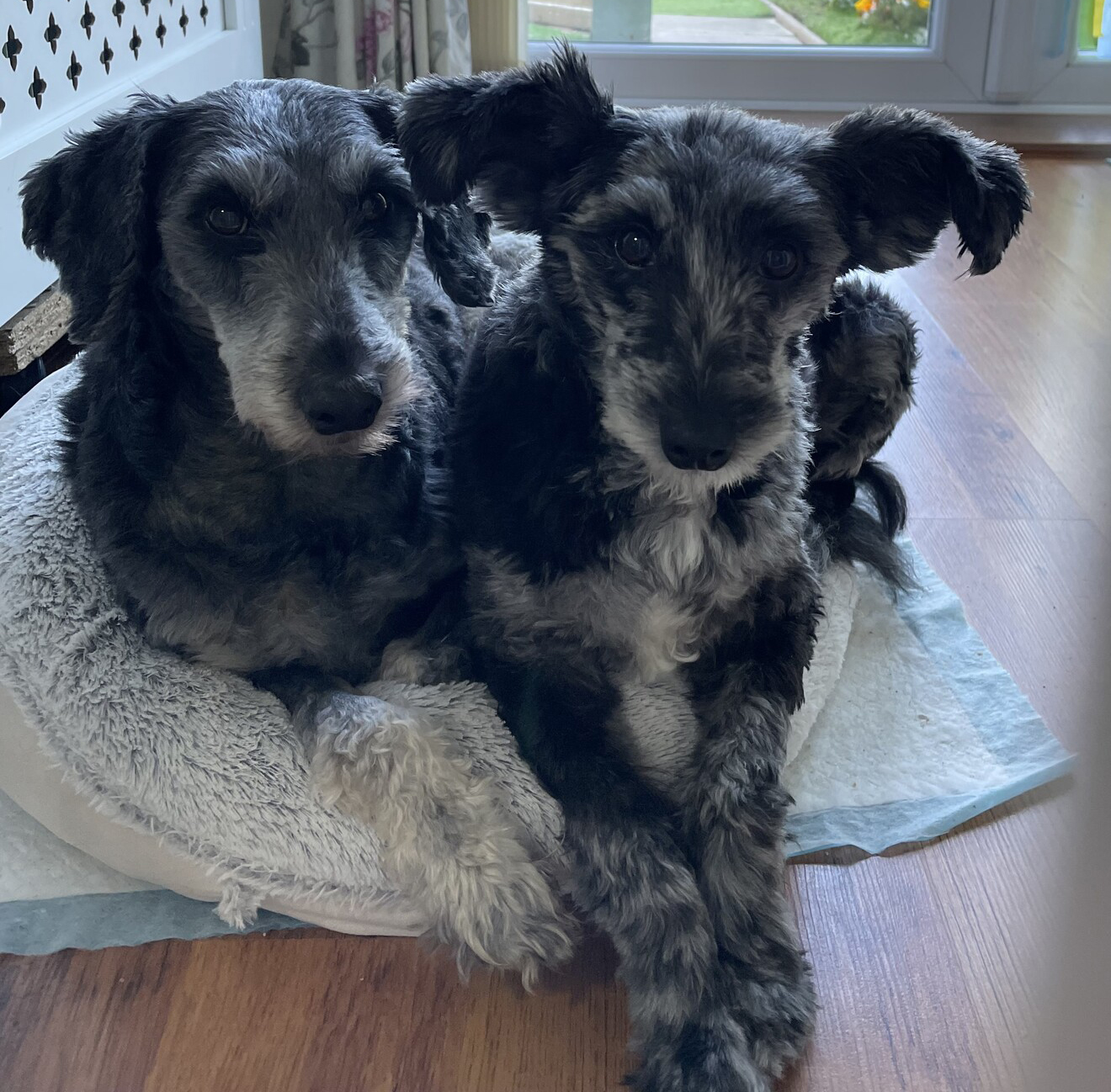
“I was so excited when I went to collect Mollie,” Dave says. “But she sauntered over to me as if nothing was the matter at all – she’d just been having a little holiday with Blue Cross. Of course, Dixie was over the moon to see her, leaping all over her. It was such a relief. I’d worried that if I lost Mollie, Dixie might die too, of a broken heart.”
Mollie was on some medication and had to visit Blue Cross once a fortnight to have her blood levels checked.
“I thought Mollie might be scared going back to hospital but she walked in, tail wagging and happy to see all her friends again,” Dave says.
And, at every visit, it was good news – Mollie’s bloods were holding stable. She was a lively, healthy six-year-old dog.
“We’re all so happy for Dave – we know how much Mollie means to him,” Emma says.
For his part, Dave is just incredibly grateful to live so close to Grimsby Blue Cross.
“I’m so lucky to have the hospital on my doorstep,” he says. “Along with the amazing doggie blood donor, they saved Mollie’s life.”