
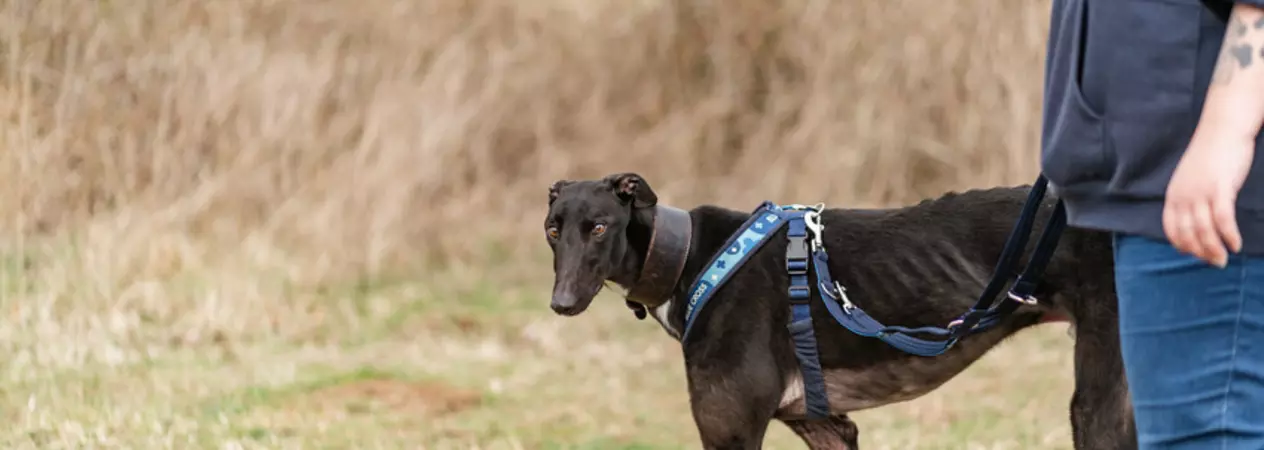
Cricket overcomes racing injury for a brighter future
When an injury on the racetrack left Cricket unable to compete, it was the end of life as he knew it – but the beginning of a much happier future.
The three-year-old greyhound, originally from Ireland, arrived at Blue Cross in February (2025) following complex surgery to repair his fractured right hock, which is the equivalent to a human ankle.
The operation involved two screws being drilled into the bone to hold it in place, alongside a plaster cast. But one of the screws later needed to be removed due to complications in the healing process.
It was a long and painful recovery for poor Cricket – and, sadly, a scenario all too common among greyhounds being forced to race in the UK, despite mounting pressure for a nationwide ban on the so-called sport.
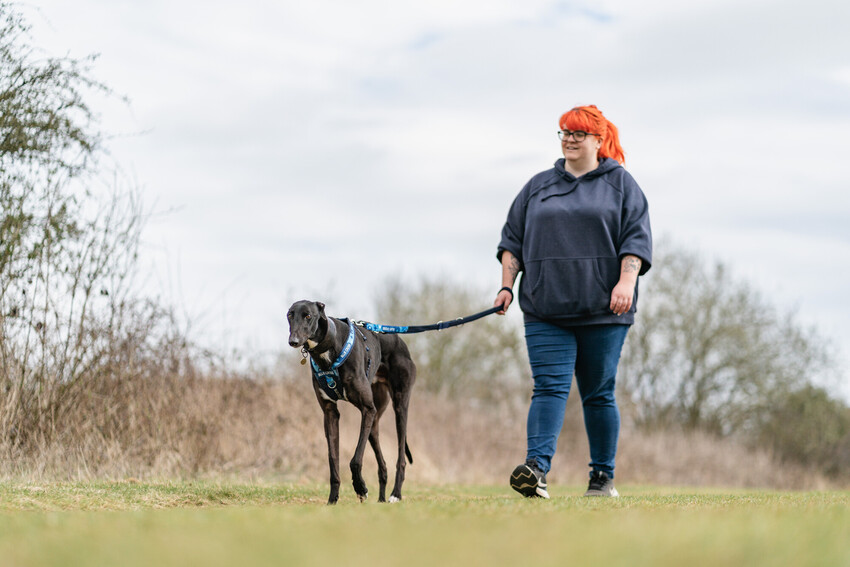
“Hock injuries like Cricket’s occur more commonly in racing greyhounds than in other dogs,” explains Blue Cross Head Vet, Jack Meier.
“A high percentage of these injuries occur in the right back leg – the anti-clockwise nature of the racing track means high forces are applied to the limb while the dog is running.”
Thankfully, Cricket didn't need further surgery after arriving at Blue Cross. His condition started to improve with anti-inflammatory painkillers and a short period of strict rest.
He continued his recovery and rehabilitation at our Burford rehoming centre in Oxfordshire.
Hannah Wiltshire, Burford Centre Manager, says: “He initially had a week of regular short five-minute trips to one of our grassy areas, and then a week of 10 minutes walks and a week of 15-minute walks before he was back to normal exercise levels.
“Volunteers sat with him often and he had plenty of food enrichment in kennels, like lick mats, to keep him mentally stimulated when his exercise was restricted.”
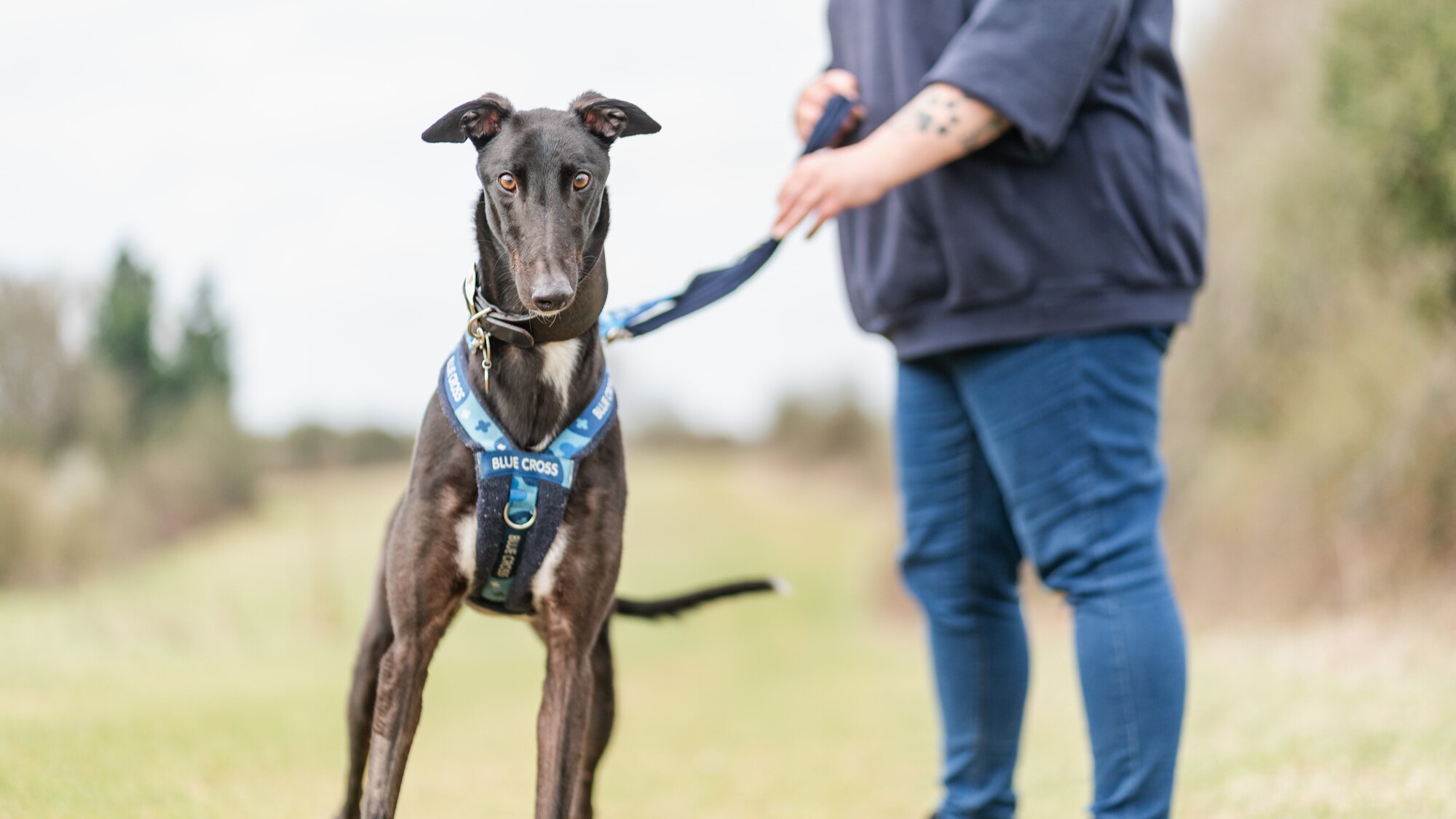
As Cricket had only ever known life as a kennel dog, his team of carers also needed to prepare him for his future as a much-loved pet.
Hannah continues: “We gave him time in the home room, so he got to experience a sofa, and he spent periods in the office and offsite with various members of the team. And he thrived in those environments.”
Cricket also spent three weeks with one of our volunteer foster carers in which he really got into the swing of living in a home full-time.
“He was a pretty solid greyhound, a very sweet boy and a volunteer favourite. He always wanted to greet people and say ‘hi’ and loved his big group walks with up to six other dogs,” adds Hannah.
Despite greyhounds making wonderful pets, they are often overlooked by potential adopters.
Case in point is the four months and four days that Cricket spent waiting for the home he deserved.
He’s now experiencing all the joy of being loved for him, rather than his speed on a track.
Help us ban greyhound racing for good
Cricket is one of the lucky ones. Between 2017 and 2024, over 4,000 greyhounds died and more than 35,000 injuries were recorded* as a result of their involvement with the cruel practice of greyhound racing.
That’s why Blue Cross has long been calling on all four nations of the UK to ban greyhound racing. There are only six other countries in the world where the spectator sport is still legal.
The Welsh Government recently announced they would be bringing forward plans to end greyhound racing – a huge step towards preventing injuries and deaths for the dogs involved – and we hope England, Scotland and Northern Ireland soon follow suit.
*Greyhound Board of Great Britain, Annual Injury and Retirement Data, last published June 2025
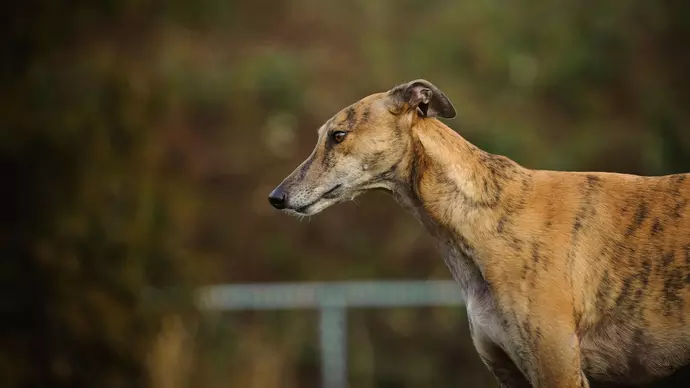
End greyhound racing
The industry still hasn’t listened to welfare advice. It’s time to stop dog exploitation.
End greyhound racing
The industry still hasn’t listened to welfare advice. It’s time to stop dog exploitation.

Why it's time to end greyhound racing
Why it's time to end greyhound racing